
On October 30, the Justice Department announced federal registrations for more than 900 medical marijuana dispensaries in seven states (DOJ), none with an operating adult-use market (CRB Monitor). California is not among them, although 771 California businesses are on the DEA’s timely-applicant list as of November 7.
The DEA also issued an order to show cause proposing to deny In-Dispensary in Minneapolis. The order says Minnesota’s “dual-purpose marijuana license, permitting both medical and non-medical dispensing falls outside the recent promulgated definition of ‘state medical license’” (Marijuana Moment). California runs a dual market too, and its A/M license split could be tested against that reasoning.
Why the Minnesota order reaches California
The DEA’s objection targets the state framework, not the applicant’s conduct. The order says the DEA “cannot permit any applicant operating under” Minnesota’s law into the federal system (Marijuana Moment). Because Minnesota “allows licensees to participate in both the non-medical and medical marijuana markets,” the order says, the regime “fails to provide ‘robust protections’ against diversion” (CRB Monitor). Its other grounds are specific to Minnesota.
The federal definition covers a license authorizing activity “for medical purposes” (21 C.F.R. § 1300.01). It does not say “only,” but the DEA appears to read it that way.
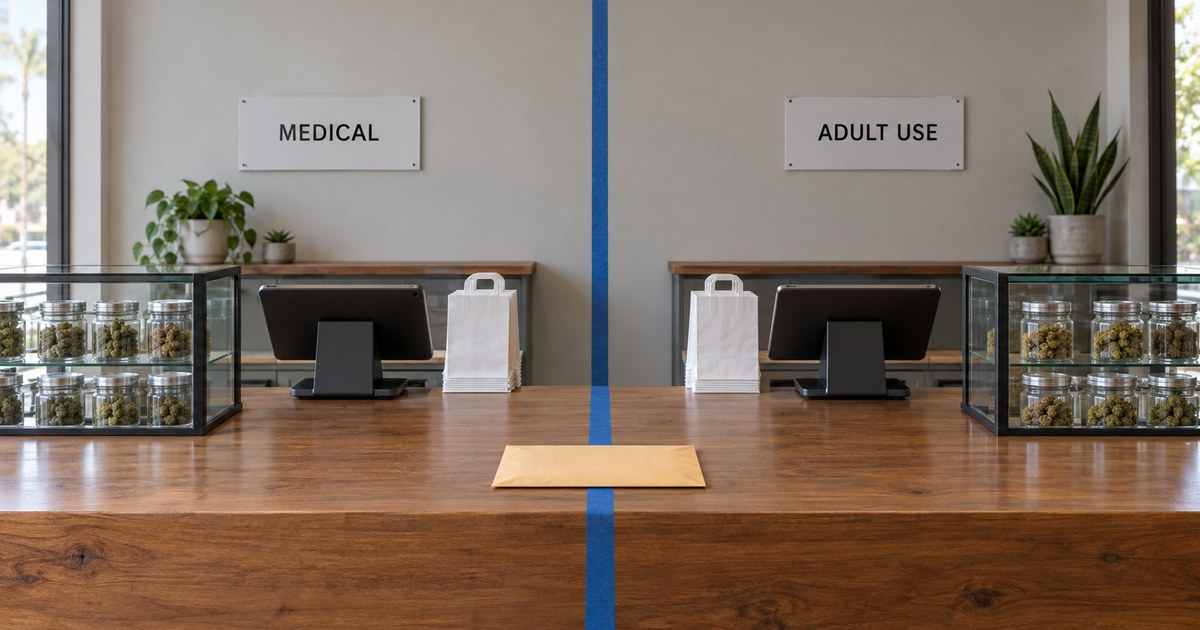
California’s emergency rule lets a retailer split one A-and-M license into two, held by separate entities at the same premises. Both must share the same individual owners and designated responsible party, keep goods and records separate, and be “jointly and severally liable for all obligations, debts, and violations incurred under either license” (Cal. Code Regs., tit. 4, § 15000.2(b)). Separate licenses could answer Minnesota’s single-license problem. Identical owners, one storefront, and shared liability may not answer the “participate in both markets” problem.
The DEA has already looked through corporate structure. In MedPharm Research, it denied a Colorado applicant whose parent and sister companies, “all of which are managed by the same CEO,” had “diverted marijuana into the recreational market.” The applicant planned to operate at its sister company’s facility. That was a default order on a 2016 Schedule I application, but the reasoning holds.
The Minnesota order is not final. In-Dispensary has 30 days from receipt to request a hearing (21 C.F.R. § 1301.43).
November 29 comes first
DEA guidance lets businesses that applied by June 26 keep operating while their applications are pending, dealing only with other timely applicants and registrants, and expects them to “establish compliant supply chains no later than November 29, 2026” (DEA). Dealing with anyone else “could be potential grounds for denial.” A California M-retailer’s suppliers must therefore be timely applicants or registrants.
Comments are due December 14
DCC proposed permanent split rules on October 30, with comments due December 14 (DCC-2026-04-R), and on November 5 noticed readoption of the emergency rule (DCC), which otherwise expires December 2 (OAL). Operators can consider using that rulemaking to ask for the separation the DEA appears to want.
Checklist for California A/M operators
- Supply chain. For every M-side trading partner, keep the DEA confirmation or certificate, verified document control number, and active DCC license on file (regulatory compliance).
- Contracts. Add DEA-status representations, notice duties, and termination rights to supply agreements before November 29 (commercial contracts).
- Separation. Document separation beyond the four regulatory conditions, including officers, bank accounts, and minutes (corporate law).
- Response plan. Be ready to request a hearing within 30 days of any order to show cause, and consider commenting to DCC by December 14 (administrative law).
Bottom line
For California, separate licenses (as currently envisioned in the DCC regulations) may be necessary but not sufficient. Operators who document separation and clean up supply chains will be best-placed if the DEA’s Minnesota reasoning comes west.
The Law Office of Shay Aaron Gilmore advises California operators on DEA registration, A/M splits, and orders to show cause through its cannabis and hemp legal services.
Related: Is Your California Cannabis Contract Enforceable in Court?
Legal commentary, not legal advice.
Posted By

Shay Aaron Gilmore is a California cannabis and hemp business attorney based in San Francisco, serving operators, investors, and cannabis startups across California. He advises clients on DCC regulatory compliance, cannabis licensing, corporate formation, intellectual property, commercial contracts, and administrative law proceedings. Recognized by the Daily Journal as a Top 20 Cannabis Lawyer in California and by Super Lawyers® as a Top 100 Northern California attorney, he is a leading voice in California cannabis and hemp law.