Update (October 7, 2026): The Continuing Appropriations and Extensions Act, 2027 (P.L. 119-103), enacted September 2, 2026, split the effective date of the federal hemp redefinition in § 781 of P.L. 119-37. The exclusion for intermediate and final hemp-derived cannabinoid products containing cannabinoids the cannabis plant cannot naturally produce takes effect November 12, 2026. The rest of the new definition takes effect December 11, 2026, including the 0.3% total-THC limit (including THCA), the exclusions for viable seeds above that limit and for products containing naturally producible cannabinoids synthesized or manufactured outside the plant, and the cap of 0.4 mg per container of total THC and similar-effect cannabinoids combined for final products. As of September 28, 2026, FDA had not published the cannabinoid list the law required within 90 days of enactment. Bills have been introduced to delay the new definition for two more years (H.R. 7024, H.R. 7010, S. 3686) or to repeal it (H.R. 6209) (CRS, IF13136).
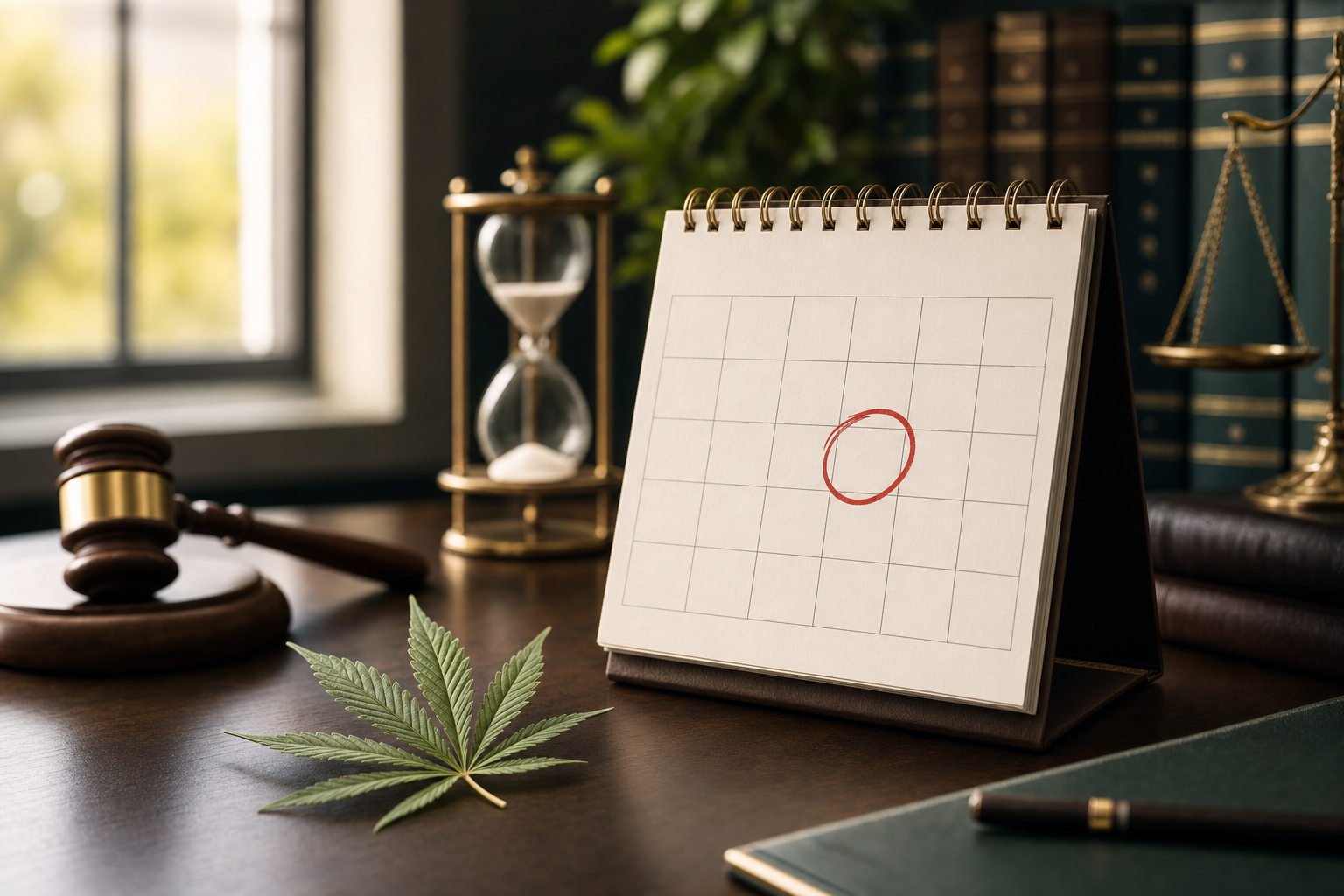
Every California hemp operator has November 12, 2026 circled on their calendar. That is the day the federal redefinition of “hemp” takes full effect, converting most intoxicating cannabinoid products — delta-8, delta-10, THCA flower, anything over 0.4 milligrams of total THC per container — into Schedule I controlled substances (Pub. L. 119-37, Div. B, § 781, amending 7 U.S.C. § 1639o).
Key dates at a glance:
- Nov. 12, 2025 — Hemp redefinition signed into law (Pub. L. 119-37); one-year transition clock starts.
- ~Sept. 13, 2026 — Federal and Cal-WARN 60-day notice deadline for layoffs tied to the ban.
- Nov. 12, 2026 — Redefinition takes full effect; non-compliant products become Schedule I.
WARN thresholds and timing depend on your specific facts — see the analysis below.
If you run a hemp business large enough to be planning workforce reductions around that date, November 12 is the wrong day to watch. Your real legal deadline is roughly September 13, 2026 — sixty days earlier. Miss it, and a closure that Congress forced on you becomes a payroll liability you owe your own workers.
The federal Worker Adjustment and Retraining Notification (WARN) Act requires covered employers — those with 100 or more employees — to give 60 days’ written notice before a “plant closing” or “mass layoff” (29 U.S.C. § 2102(a)). A plant closing is a shutdown costing 50 or more employees their jobs in a 30-day window; a mass layoff reaches 50 or more when that group is at least a third of the site’s workforce (29 U.S.C. § 2101(a); 20 C.F.R. § 639.3).
Now run the arithmetic most ban coverage skips. If a processor knows it must shut down intoxicating-cannabinoid lines on November 12, and knows that shutdown crosses a WARN threshold, the 60-day clock puts notice on or about September 13, 2026. Wait for the ban to bite before handing out notices, and you are already in violation on day one.
The price is concrete: back pay and benefits for each day of the violation, up to 60 days, plus a civil penalty up to $500 per day (29 U.S.C. § 2104(a)). That is a six-figure mistake bolted onto a business you are already being forced to close.
“The government banned my product” won’t save you
Here is the argument operators will reach for, and why it fails.
WARN has a narrow escape hatch — the “unforeseeable business circumstances” exception — that can shorten the 60 days when a closing is caused by a sudden condition outside the employer’s control (29 U.S.C. § 2102(b)(2)(A); 20 C.F.R. § 639.9(b)). “Congress made my inventory a felony” sounds like exactly that.
It isn’t. The hemp provision was signed November 12, 2025 — a full year before its effective date (Pub. L. 119-37). That runway is fatal to the exception, which by regulation covers conditions “not reasonably foreseeable” and caused by something “sudden, dramatic, and unexpected” (20 C.F.R. § 639.9(b)(1)–(2)). A shutdown date printed in the U.S. Code for twelve months is neither. An employer claiming surprise in November 2026 is not describing an unforeseeable event; it is describing a deadline it chose to ignore.
That is the counterintuitive core here: a compliance-driven closure, where the government set the date far in advance, may be the least excusable kind under WARN.
If you operate in California, federal law is only the floor. The California WARN Act (Cal. Lab. Code §§ 1400–1408) reaches further:
- Lower threshold. Cal-WARN covers any “covered establishment” with 75 or more employees — and counts part-time workers, which federal law does not (Cal. Lab. Code § 1400(a)). A manufacturer under the federal radar can still owe full state notice.
- New 2026 content rules. SB 617, signed October 1, 2025 and effective January 1, 2026, amended § 1401 to add four mandatory disclosures to every notice (Cal. Lab. Code § 1401). A notice that was compliant last year can now be legally deficient, and each day of deficiency is a separate violation (§ 1402; § 1403).
- Rolling aggregation is the sleeper. WARN counts job losses across a rolling 30-day window. California’s hemp sector has already been contracting under stricter state rules — AB 8 (Ch. 248, Statutes of 2025) and the CDPH framework predate the federal ban (Cal. Legislative Information, AB 8). Earlier 2025–2026 cuts can aggregate with ban-driven reductions, pushing you over a threshold sooner than expected.
Some California hemp employers may already be closer to a trigger than they realize.
What to do in the runway you have
None of this is cause for panic — it is cause to get the sequence right while time remains:
- Run the headcount math against both statutes (federal 100; Cal-WARN 75, part-timers included), counting across the rolling window and any 2026 cuts already made.
- Back-date from November 12. If a threshold is in play, notice is due on or about September 13, 2026 — not the ban date.
- Don’t rely on the “unforeseeable circumstances” exception. The year-long runway almost certainly forecloses it. Plan for full notice.
- Get the California content and recipients right. SB 617’s four new disclosures plus EDD, Local Workforce Development Board, and elected-official service are mandatory.
- Coordinate the workforce timeline with your wind-down. Employment obligations, inventory sell-through, and lease commitments all key off November 12 and are easier managed together.
The hemp ban will reshape a lot of California businesses, and the operators who fare best are treating the year of runway as a planning window, not a countdown. The WARN calculus is one thread in a larger transition — inventory, leases and supply contracts, trademark protection, and entity structuring all key off the same date and are stronger when they move together.
That kind of coordinated transition planning — including the California employment and labor issues that surface along the way — is the work I do with hemp and cannabis operators. If you’re mapping how your business meets the November deadline, the time to build the plan is now, while the full set of options is still open.
Posted By

Shay Aaron Gilmore is a California cannabis and hemp business attorney based in San Francisco, serving operators, investors, and cannabis startups across California. He advises clients on DCC regulatory compliance, cannabis licensing, corporate formation, intellectual property, commercial contracts, and administrative law proceedings. Recognized by the Daily Journal as a Top 20 Cannabis Lawyer in California and by Super Lawyers® as a Top 100 Northern California attorney, he is a leading voice in California cannabis and hemp law.