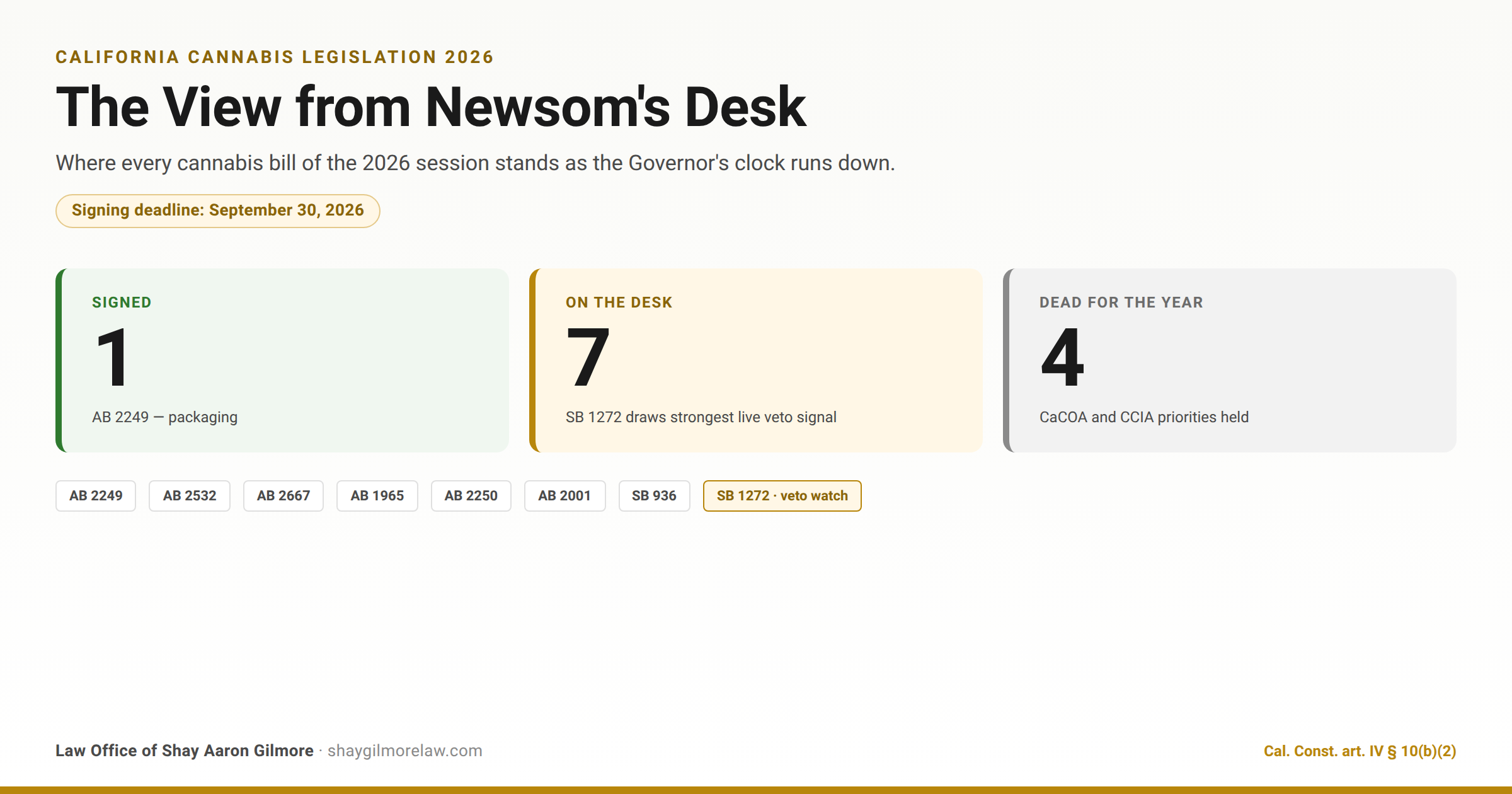
As the smoke clears from an end-of-session sprint that Capitol observers are calling the most frenetic since Proposition 54 imposed its 72-hour print rule in 2016, the California Legislature has adjourned and left Governor Newsom a desk stacked with cannabis measures. More than 70 bills were amended in the final 48 hours before the deadline — nearly three times the previous post-Prop-54 high — and a wildfire-liability standoff forced both houses back into floor session on September 1 to finish votes on budget trailers and urgency bills that the constitutional midnight cutoff could not have reached the day before. Under Article IV, § 10(b)(2), the Governor has until September 30 to sign or veto every measure delivered on or after September 1. Of the cannabis-relevant bills that survived the crush, one is already law, seven wait on the Governor’s desk, and four are dead for the year.
AB 2249 (Irwin) — now Chapter 164, Statutes of 2026 — rewrites the MAUCRSA “attractive to children” standard in Bus. & Prof. Code § 26120 as a defined term with specific prohibited motifs: cartoons, mythological creatures, characters primarily associated with children’s entertainment, imitations of products marketed to children, and overly-stylized fruit imagery on edibles and vape cartridges. DCC must publish a standardized rubric and a voluntary pre-clearance program by July 1, 2027; the packaging bar itself takes effect January 1, 2028. Pre-clearance capacity will be limited from day one, so operators should be budgeting the rebrand cycle now.
The remaining bills group naturally by subject. On packaging and product safety, AB 2532 (Irwin) — enrolled after the originally proposed 10 mg beverage cap was stripped — would put the Poison Help number on every label and require serving-count disclosure and a free measuring instrument for multi-serving beverages. Its natural companion is AB 2667 (Hadwick/Wicks), which bans vapes that imitate consumer products or use minor-appealing branding and, more consequentially, gives DCC new authority to suspend or revoke a license for violations. Vape brands should treat AB 2249 and AB 2667 as a single compliance exam.
On lab operations, AB 1965 (Sharp-Collins) removes a persistent workflow bottleneck by letting testing labs retest samples compromised by equipment malfunction or staff error without prior DCC authorization, while requiring COAs on customer request and periodic DCC performance-testing for inter-lab consistency.
On product classification, AB 2250 (Aguiar-Curry) widens the isolate lane by excluding CBN — alongside the CBD isolate already carved out — from the “cannabis concentrate” definition effective January 1, 2028, with related Cannabis Tax Law cleanup.
On enforcement, AB 2001 (Stefani) adds an express Penal Code § 11105 cross-reference to the illegal-cultivation authorities in Bus. & Prof. §§ 26037.5, 26038, and 26038.1, formalizing an AG-to-city-attorney data channel that already runs in practice. SB 936 (Blakespear), the nitrous oxide bill, matters here because it authorizes a court to suspend a tobacco or cannabis license for a prior conviction — a licensing consequence that reaches every hybrid retailer.
The last bill on the desk is not cannabis on its face but sits on the same enforcement statute that AB 1684 uses. SB 1272 (Menjivar) would amend Gov. Code § 53069.4 to require a six-month correction period before administrative fines may issue for building, plumbing, electrical, or zoning violations on owner-occupied homes where the owner submits a sworn affidavit of no prior knowledge. Read alongside AB 1684’s no-cure cannabis-fine authority, SB 1272 tightens where and against whom local jurisdictions may move first.
Four bills went nowhere. AB 2697 (Pellerin), on cannabis drive-throughs, was moved to the Senate inactive file at the author’s request. Two industry-sponsored due-process bills — AB 2537 (Chen), the CaCOA-sponsored risk-based-enforcement measure, and AB 1826 (Lackey), the CCIA-sponsored recall and embargo bill — were held under submission. AB 2506 (Hart), the tribal-state cannabis compact bill requiring a two-thirds AUMA amendment, also stalled. Expect the two due-process measures back in 2027.
Nothing on the desk carries an obvious veto valence, but a few signals are worth naming. SB 1272 drew an Oppose position from the California State Association of Counties — the local-government line Newsom has historically weighed on § 53069.4 bills. AB 2001 has civil-liberties opposition on data-sharing grounds recorded in the Senate Public Safety Committee analysis. AB 2532’s earlier industry OPPOSE coalition stood down after the 10 mg cap was stripped, and the remaining four bills cleared their final votes 39–0, 40–0, 74–0, and 78–0 — the shape of bills that get signed.
Posted By

Shay Aaron Gilmore is a California cannabis and hemp business attorney based in San Francisco, serving operators, investors, and cannabis startups across California. He advises clients on DCC regulatory compliance, cannabis licensing, corporate formation, intellectual property, commercial contracts, and administrative law proceedings. Recognized by the Daily Journal as a Top 20 Cannabis Lawyer in California and by Super Lawyers® as a Top 100 Northern California attorney, he is a leading voice in California cannabis and hemp law.