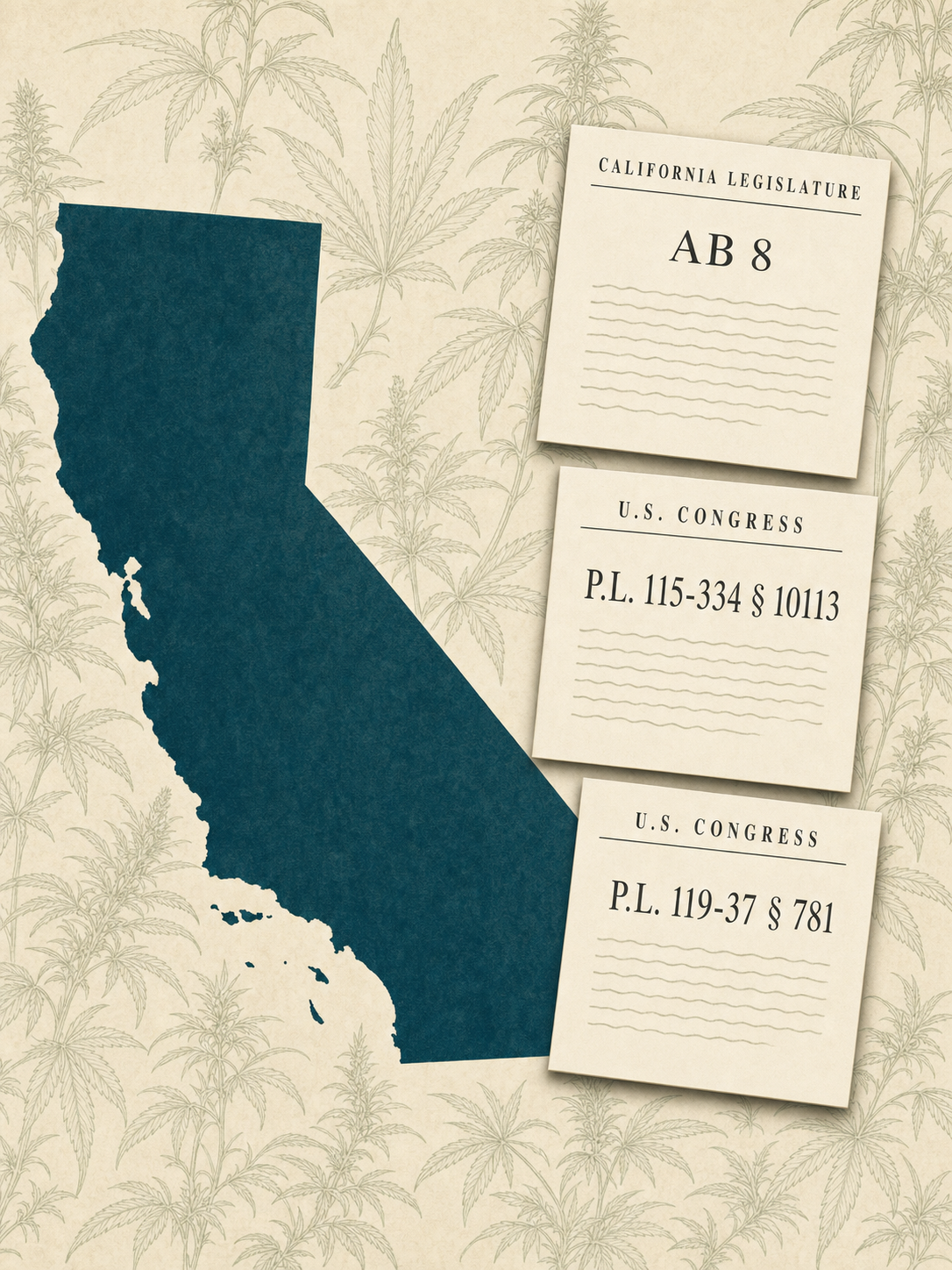
In just over 100 days, on November 12, 2026, H.R. 5371 § 781 redefines federal “hemp”: total THC rather than delta-9, a 0.4 mg per-container cap, and no synthetic or converted cannabinoids. Anything outside the new definition is federally marijuana, with all the consequences that follow under the Controlled Substances Act. California operators have been living inside a version of that regime under AB 8 since January, and clients keep asking how it compares.
Three approaches have emerged for assigning intoxicating hemp to cannabis regulators; California uses the most complex, and 33 states sit outside all three. California is not a preview of the federal regime — it is one specific version of “hemp under the cannabis regulator,” with design choices no other state made. This downloadable 50-state reference shows the spectrum; what follows in this blog post is where California sits on that spectrum.
California’s approach in brief
California channels intoxicating hemp products above a defined threshold into licensed cannabis retail, sorting by product form and dose tier rather than a single ceiling (AB 8 as chaptered, Ch. 248, Stats. 2025). AB 8 restricts high-THC hemp products to the DCC-licensed adult-use market on staged 2026–2028 effective dates (CDPH AB 8 FAQ) and authorizes inhalable manufacturing for out-of-state sale — one of three states with an express export carve-out, alongside Colorado (SB 23-271) and Connecticut (PA 25-166).
California vs. the other channeling states
Eleven other states — Washington, Ohio, Vermont, Maryland, Oregon, New Jersey, Illinois, Missouri, Colorado, Connecticut, and Delaware — also channel intoxicating hemp into licensed cannabis retail. They differ from California at the threshold. Ohio matched the federal 0.4 mg per container (ORC § 3796.02, effective March 20, 2026). Washington went further — “any detectable THC” triggers cannabis licensure (SB 5367). Vermont splits the difference at 1.5 mg per serving / 10 mg per package (CCB hemp page). Delaware’s HB 373 routes THC beverages through both OABCC package stores and marijuana retailers (HB 373 § 1313).
California’s product-and-tier sort is a different beast: AB 8 varies treatment by product form, potency band, and license type (CDPH AB 8 FAQ). A low-dose beverage and a high-THC vape run on different tracks in California; Ohio would treat them identically.
Colorado’s safe-harbor regime and Connecticut’s high-THC beverage endorsement authorize out-of-state manufacture, as does California for inhalables. On November 12 those authorizations meet a federal redefinition that governs interstate commerce regardless of origin-state blessing.
Illinois and Missouri tied their statutes to the federal date: Illinois’ Hemp Act is effective November 12, 2026, and Missouri’s HB 2641 applies “only during any period in which the Federal restrictions prohibit those products.” California has no equivalent contingency — AB 8’s dates run on their own regardless of § 781.
California vs. the parallel-program states
New York, Minnesota, and Rhode Island took a different path: same regulator, separate license stacks. New York’s Office of Cannabis Management administers both under 9 NYCRR Part 114; Minnesota’s SF 4401 / Ch. 123 removed the dual-license bar in 2026; Rhode Island’s Cannabis Control Commission promulgated the hemp program under 560-RICR-10-20-1 (1 mg per serving / 5 mg per package, effective December 2025).
The parallel design gives low-dose hemp businesses a path California doesn’t: a dedicated hemp license instead of paying into cannabis licensing priced for adult-use inventory. In California it is DCC-licensed retail or squeezed out — CDPH projected $602 million in first-year revenue losses to California hemp businesses (SRIA Supplement, DPH-24-005).
California vs. the consolidation-without-retail states
Virginia and Michigan consolidated hemp under the cannabis regulator but declined to open dispensary shelves. Virginia caps products at 2 mg per package (Va. Code § 4.1-1700; SB 543). Michigan issues hemp processor-handler licenses through the CRA but keeps hemp retail outside dispensary walls (Mich. Admin. Code R 420.1003).
California and Virginia are opposite ends of the same design: California has a functioning adult-use retail market (4.27 retail licenses per 100,000 residents); Virginia has the licensing structure without the outlets (earliest sales July 1, 2027). Virginia is not presently a peer market to California.
California vs. the states outside all three approaches
The 33 states outside the three approaches sort into four buckets.
Ban states — Alaska, Arizona, Arkansas, Idaho, Indiana, Massachusetts, North Dakota, South Dakota, Wyoming, and Texas as of July 31, 2026 — prohibit intoxicating hemp entirely, most treating delta-8 as Schedule I. The Texas Supreme Court reversed the Sky Marketing injunction May 1, 2026, and DSHS reinstated Schedule I status for non-delta-9 THCs effective July 31; the Eighth Circuit did the same for Arkansas’s Act 629 June 24, 2025. Product routed into these states is illegal regardless of AB 8 compliance at origin.
Alcohol-regulator states — Alabama, Louisiana, and Tennessee — route retail permits through their alcohol agencies, each with statutory dose caps: Alabama’s ABC Board at 10 mg per serving; Louisiana’s ATC at 5 mg per serving; Tennessee’s TABC took jurisdiction January 1, 2026 under Public Chapter 526. Distributors need a licensed alcohol counterparty, not a cannabis dispensary.
Potency-capped general retail — Hawaii, Iowa, Montana, New Mexico, Utah — permits hemp retail without cannabis-channeling but imposes statutory total-THC and per-serving caps (1 mg per serving in Hawaii, 0.5 mg in Montana; Utah bans smokable flower). California formulations may or may not clear them.
Age-gated general retail — Florida, Georgia, Kentucky, Maine, and West Virginia — gate sales at 21 without statutory milligram caps. Georgia’s per-serving limits live in GDA Rule 40-32-5-.06, not in SB 494; SB 254 would have codified them but died at sine die April 3, 2026.
Unregulated — Kansas, Mississippi, Nebraska, Nevada, New Hampshire, North Carolina, Oklahoma, Pennsylvania, South Carolina, Wisconsin, and DC — have no consumer framework. Nevada’s SB 356 failed; an AB 76 study is due November 9, 2026. New Hampshire’s SB 461 died May 21, 2026. A federal § 781 backstop matters most here.
AB 8 has been California operators’ daily reality since January, and § 781 does not soften it. Nor has any promised federal clarity come — FDA missed the § 781 February 10, 2026 deadline to publish cannabinoid lists and container definitions. For California cannabis and hemp operators, the November 12 exposure is not a federal problem arriving from outside — it is a state statute already in force, waiting to collide with a federal redefinition.
Legal commentary, not legal advice. For matter-specific guidance on cannabis licensing, hemp compliance, restructuring, or interstate distribution, contact the Law Office of Shay Aaron Gilmore.
Related: Cannabis and Hemp Law Blog · Cannabis Regulatory Practice · Business Restructuring
Posted By

Shay Aaron Gilmore is a California cannabis and hemp business attorney based in San Francisco, serving operators, investors, and cannabis startups across California. He advises clients on DCC regulatory compliance, cannabis licensing, corporate formation, intellectual property, commercial contracts, and administrative law proceedings. Recognized by the Daily Journal as a Top 20 Cannabis Lawyer in California and by Super Lawyers® as a Top 100 Northern California attorney, he is a leading voice in California cannabis and hemp law.