Update (October 7, 2026): The Continuing Appropriations and Extensions Act, 2027 (P.L. 119-103), enacted September 2, 2026, split the effective date of the federal hemp redefinition in § 781 of P.L. 119-37. The exclusion for intermediate and final hemp-derived cannabinoid products containing cannabinoids the cannabis plant cannot naturally produce takes effect November 12, 2026. The rest of the new definition takes effect December 11, 2026, including the 0.3% total-THC limit (including THCA), the exclusions for viable seeds above that limit and for products containing naturally producible cannabinoids synthesized or manufactured outside the plant, and the cap of 0.4 mg per container of total THC and similar-effect cannabinoids combined for final products. As of September 28, 2026, FDA had not published the cannabinoid list the law required within 90 days of enactment. Bills have been introduced to delay the new definition for two more years (H.R. 7024, H.R. 7010, S. 3686) or to repeal it (H.R. 6209) (CRS, IF13136).
Since it began enforcing California’s 2024 emergency hemp regulations, the state’s Department of Alcoholic Beverage Control has logged more than 22,000 visits to licensed premises looking for illegal hemp products and watched violations fall to almost nothing — from 83 in the first month to a single violation across the opening months of 2026, a drop of nearly 99 percent (ABC, Illegal Hemp Enforcement). Read quickly, it looks like a cleanup that worked: the bars and restaurants pulled the THC seltzers, and the inspectors stopped finding much of anything. But I would not read the numbers that quickly. ABC counts the doors it licenses, and a clean record at those doors says little about a trade that never really needed them to begin with.
Anyone operating in this space already knows the market did not disappear when the licensed shelves began to clear; it relocated to the unlicensed channels it largely came from. The more useful question for operators and investors is what the state’s own enforcement records and budget documents reveal about the next move: where California now believes that displaced market is, how it has funded itself to reach it, and how fast the remaining windows close. Those documents are more blunt on all three than the quiet ABC table lets on, and they converge on a single near-term date — July 1, 2026, now weeks away — when the state both reorganizes its enforcement agencies and turns the online marketplaces against the unlicensed sellers operating through them.
The Arbitrage That Built the Category
The intoxicating-hemp-beverage business has always operated on definitional arbitrage. Federal law since 2018 has defined hemp by a single threshold — delta-9 THC at or below 0.3 percent by dry weight — and treated everything under that line as an agricultural commodity rather than a controlled substance. Chemists and marketers did the rest: extract or convert cannabinoids, keep the delta-9 number nominally low, and sell something intoxicating in effect while remaining, on paper, “hemp.”
A THC beverage sold through a licensed dispensary is taxed, tested, tracked, dose-capped, and kept from anyone under twenty-one. A nearly identical beverage labeled “hemp” could move through a grocery distributor or a liquor license, outside that entire apparatus. The point is not that one product was safe and the other dangerous; the molecules did not care which statute governed them. Two bodies of law assigned wildly different burdens to the same intoxicant, and an entire category organized itself around the cheaper one. I have written before about how that hemp-cannabis dividing line keeps moving even as federal rescheduling unifies parts of the tax picture; the current hemp beverage trade is what happens when a business model is built on top of an “intoxication” line that was never designed to hold still.
What the Enforcement Record Shows — and Where It Goes Silent
On September 23, 2024, emergency regulations proposed by the California Department of Public Health took effect, barring the sale of ingestible industrial hemp products containing any detectable total THC or other intoxicating cannabinoids. The Department of Alcoholic Beverage Control drew the job of enforcing those rules against its own licensees, and has kept a public tally. Since the rule took effect, ABC reports the following at licensed locations:
| Period | Location Visits | Violations | Products Seized |
|---|---|---|---|
| October 2024 | 2,619 | 83 | 4,680 |
| November 2024 | 1,811 | 36 | 1,361 |
| December 2024 | 1,536 | 13 | 861 |
| January–December 2025 | ~10,400 | 25 | ~455 |
| January–early June 2026 | ~5,600 | 1 | 46 |
| Total since Oct. 2024 | 22,023 | 158 | 7,403 |
Source: California Department of Alcoholic Beverage Control, Illegal Hemp Enforcement.
More than twenty-two thousand visits; one hundred fifty-eight violations — and they are not spread evenly. The first three months, October through December 2024, account for one hundred thirty-two of them, roughly five-sixths of the total. By 2026, ABC was running thousands of visits and finding almost nothing: a single violation against some 5,600 visits through the first part of the year.
The comfortable inference — the one a press release would draw — is that enforcement worked. I would resist it, because it asks the data to answer a question it was never built to answer. ABC counts visits to ABC-licensed premises; the table measures how the licensed behave, not whether the trade exists. A regulator who knocks only on the doors he himself licensed will, in time, find those doors in order, and learn nothing about the houses down the street he has no key to. A falling violation count is consistent with a market that complied. It is equally consistent with one that simply left.
There is a discipline for reading law this way, and Oliver Wendell Holmes Jr. gave it its sharpest statement. If you want to know the law, he wrote, “you must look at it as a bad man, who cares only for the material consequences which such knowledge enables him to predict, not as a good one, who finds his reasons for conduct, whether inside the law or outside of it, in the vaguer sanctions of conscience.” Oliver Wendell Holmes, Jr., The Path of the Law, 10 Harv. L. Rev. 457 (1897). The point is not cynicism; it is a method of observation. The bad man does not weigh what the law announces about itself, or what its enforcers hope it has accomplished. He knows a law only by its sanction — by what it punishes, how severely, and how surely the punishment lands on him. Where there is no penalty he can predict, there is, for his purposes, no law to obey. So Holmes’ bad man reads the ABC record not as a verdict on the trade but as a map of one thing: where the punishment currently falls.
Read that way, the table says something narrower and more useful than success. It marks the single place the sanction is now certain and severe: the liquor license. Selling a THC drink under an alcohol license is, for practical purposes, finished in California, because the consequence — citation, seizure, the license itself at risk — is immediate and falls on a known party. The eighty-three violations of the first month and the lone violation of early 2026 are not a story of conversion; they are the trade pricing in that sanction and clearing out of the one channel where it bites. And the bad man reads the same numbers forward. A penalty that severe in one channel, paired with no comparable penalty in the others, does not end a profitable trade; it relocates the trade to the channels that carry no predictable sanction yet. The falling violation count is, to him, a displacement signal — and the question it raises is not whether the trade survived, but which relatively unpunished channel absorbed it, and how long that channel stays relatively unpunished.
The Market the License Enforcement Table Does Not See
The intoxicating hemp trade went where a license is not on the line, and the state has said where that is. The most recent and authoritative word comes from the Governor himself. Signing AB 8 on October 2, 2025, Newsom announced “99.78% compliance” among ABC licensees and, in the same breath, declared that “nefarious hemp manufacturers have been exploiting loopholes to make their intoxicating products easily available to our most vulnerable communities.” The signing statement itself goes further, framing the problem as a national one: “Loopholes in federal law, and an absence of any meaningful action to regulate or enforce, have led to a flood of intoxicating hemp products across the nation” (Office of Governor Newsom, AB 8 signing statement). I would not buy the headline figure. The 99.78 percent is a compliance rate among ABC licensees — the same licensed-channel measure as the table above, carrying the same blind spot — offered as evidence of a problem solved in the very announcement that calls the problem a nationwide flood. The two halves of that statement do not sit together unless the flood is moving through channels the compliance rate never counted. The Governor is, in effect, selling the same partial number the ABC table reports, and the bad man discounts it for the same reason: it measures the doors the state licenses, not the trade it is chasing.
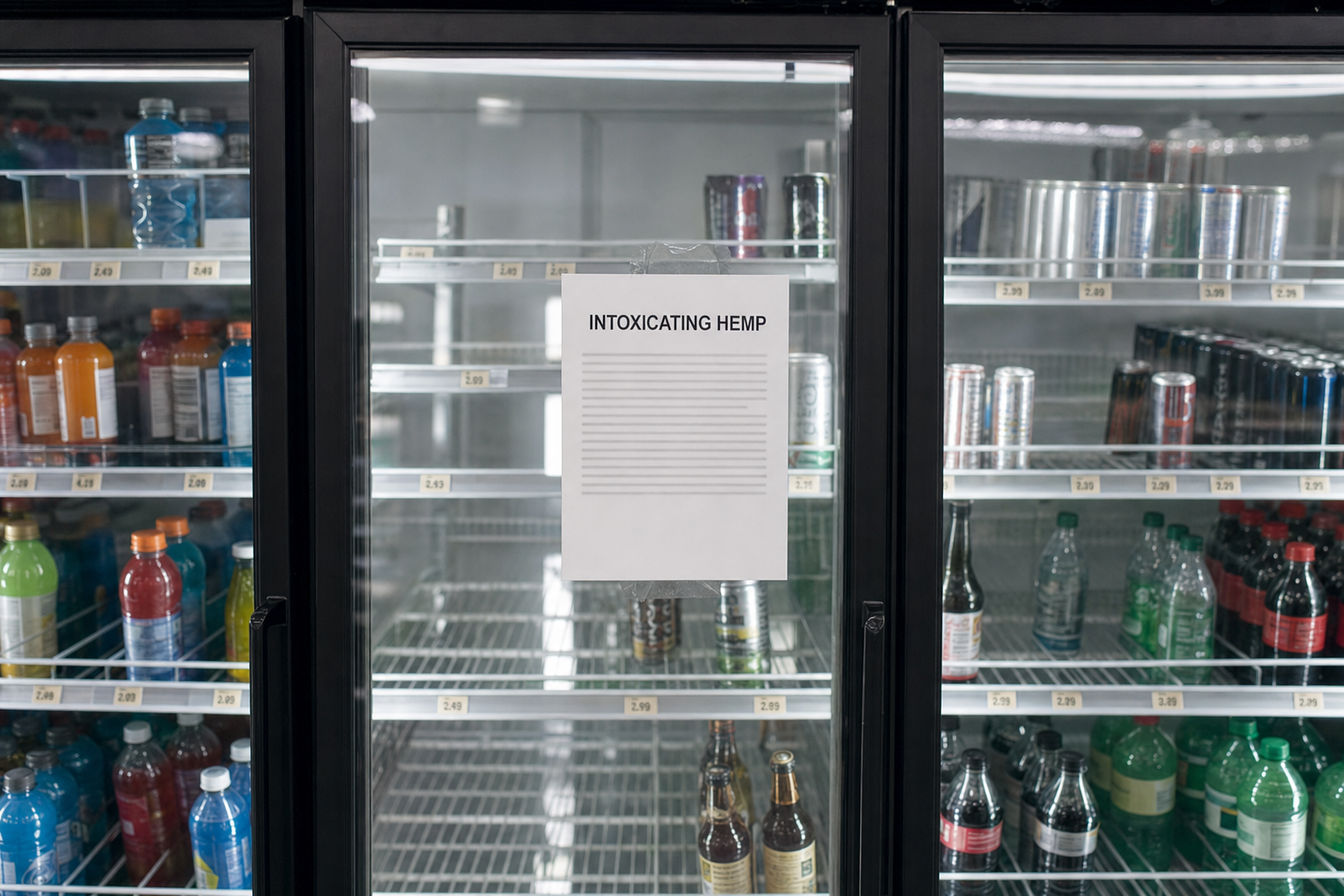
The earlier official account named those other channels directly. In a November 8, 2024 consumer alert, Attorney General Rob Bonta warned that intoxicating hemp products “are primarily sold online, gas stations, smoke shops, and liquor stores,” often at “levels of THC at many times the legal limit,” and “may also be sold by unlicensed cannabis operators” (California Attorney General, consumer alert). Those are the same four shelves a THC seltzer or a hemp-derived THC “shot” moves across, and of the four, only the liquor store — the off-sale alcohol retailer, from the corner package store to a big-box chain like Total Wine & More or BevMo — reliably holds an ABC license and shows up in the table. The other three carry no ABC sanction at all — which is precisely why, on the bad man’s reading, the trade would migrate toward them as the license sanction took hold. But “no ABC sanction” is not the same as “no consequence,” and the channels divide sharply on that point. That divide — between the pathways the state can already punish and the one it largely cannot — is where the real exposure now lies.
The brick-and-mortar channels — the gas station, the smoke shop, the convenience store — are no longer an authority gap, whatever they look like on the ground. AB 8 amended the Business and Professions Code to bar tobacco retailers, the license category most of these storefronts hold, from possessing or selling any THC-containing product as of January 1, 2026, and codified the Department of Cannabis Control’s authority over unlicensed sellers — with the inspect-seize-and-destroy powers of state and local agencies expanded that same January 1, 2026, and the full folding of hemp into the licensed cannabis supply chain set for 2028 (AB 8, California Legislative Information). Local governments have been the most active enforcer here: Sacramento County adopted an ordinance with escalating penalties and business-license revocation aimed expressly at smoke shops, gas stations, and convenience stores (Sacramento County). The gap is not who may act; it is how many storefronts a finite number of inspectors can reach — a resourcing problem, and a real one, but not a market the state has no power to touch.
The online channel fits the harder description — a market the state concedes it has struggled to reach at all — and it is where the durable gap lies. Federally compliant hemp-derived THC beverages were, until recently, shipped straight to California mailboxes by national brands; after the September 2024 rule, brands including Lucky Elk, Mood, and Hometown Hero dropped California from their eligible-states lists and geofenced the state out (THCAmap, California status). That is real retreat — but only by the visible, reputable sellers, the ones with a state list to edit at all. It says nothing about those who never published one and never meant to honor it.
The most candid description of what remains comes from the state’s own budget paperwork. In its 2026-27 budget change proposal, the Department of Cannabis Control concedes that “the online marketplace for illegal hemp products sold directly to consumers in California is sizable, but the state has taken limited enforcement action without resources available and dedicated to this work,” and that “statutory ambiguity and a lack of resources have made it challenging to enforce against online sales of intoxicating hemp products into California by manufacturers located out of state” (Department of Finance, DCC budget change proposal). A regulator does not write that into a funding request unless the market is large and largely untouched. Set the two records side by side and the trade-off is hard to miss: across the same stretch in which ABC violations fell from eighty-three to a single case, the state’s own budget paperwork was describing the online channel as “sizable” and growing beyond its reach. The clean license table and that admission are not in tension; they are the same displacement measured from opposite ends. The sanction landed hard on the license, and the volume moved to the one pathway where the state concedes it had, as yet, no sanction to impose.
The Apparatus Being Built to Follow It
If the bad man’s reading is right — that the trade went where no sanction could yet reach it — then the state’s answer is the obvious one: build the sanction. That is what is converging on July 1, 2026. The consolidation is not a tidying-up; it is the construction, channel by channel, of exactly the predictable consequences whose absence let the online market grow. The same proposal that concedes the gap asks for the money to close it, requesting 22 positions and about $7.3 million in 2026-27, roughly $5 million ongoing, expressly to implement Assembly Bill 8, including a new Civil Enforcement Unit built to investigate illegal online sales and pursue civil penalties against out-of-state sellers shipping into California (Department of Finance, DCC budget change proposal). The state does not budget that way for a market it believes is gone. What that money buys is best read not as a list of programs but as a new schedule of consequences, taken channel by channel.
AB 8, signed as Chapter 248 in October 2025, supplies the legal authority behind that spending (AB 8, California Legislative Information). It works in stages: from January 1, 2026, it bars hemp raw extract from ingestible products — beverages squarely among them — unless the extract is more than 99 percent pure and free of THC and synthetic cannabinoids, a purity standard no intoxicating seltzer can meet; from January 1, 2028, it pulls the rest into the licensed cannabis supply chain under DCC — track-and-trace, testing, the excise tax — and treats online sales into the state as regulated retail. The Department of Public Health’s own rulemaking estimate projected the ban would close roughly 115 businesses and cost more than 18,400 jobs within five years (CDPH proposed rulemaking, as reported by Cannabis Business Times). The off-ramp into the licensed market is real, but it is not free, and it is not open forever. California has also gone after the e-commerce layer at its source. SB 378 (Chapter 411, Statutes of 2025), signed October 6, 2025, requires online cannabis and online hemp marketplaces, beginning July 1, 2026, to give consumers a clear mechanism to report unlicensed sellers and intoxicating-hemp listings, bars those platforms from running paid advertising for unlicensed sellers, and verify a seller’s license before carrying its listings. The teeth are tiered: failing to verify a license or display the required warning graphic carries a civil penalty of up to $250,000 per violation — enforceable by any person who finds the violation, with attorneys’ fees on top — rising to $500,000 for violating an injunction to comply, while a defective reporting mechanism runs $10,000 per violation, and the marketplace can be held jointly liable for a consumer’s damages, doubled if it had actual knowledge and tripled if the buyer was a minor (SB 378, California Legislative Information). I testified on this bill before the Assembly Judiciary Committee as it moved through the Legislature last year, so I watched the marketplace-liability provision take shape from inside that process. The state is not only staffing investigators to chase online sellers — it is conscripting the marketplaces those sellers depend on.
On that same July 1, 2026 date, the agencies running all of this are about to share an address. ABC and the Department of Cannabis Control are being re-housed under the Business and Consumer Services Agency (BCSA), one of two new agencies created when the former Business, Consumer Services and Housing Agency is dissolved and split that day (the other entity being the California Housing and Homelessness Agency). The new BCSA is led by former federal Consumer Financial Protection Bureau director Rohit Chopra, with a stated purpose of improving enforcement coordination “amid growing threats from weakened federal enforcement” (announcement of the new agency). The seam the arbitrage exploited — the gap between the agency that governs liquor and the one that governs cannabis — is being stitched closed at the administrative level, so that enforcement authority once split across separate offices and aimed at separate channels now converges on one date and, increasingly, one online target. Read the whole of it as the bad man would — asking only what it now costs to be caught and how likely the catching becomes — and the reorganization resolves into a schedule of new penalties aimed squarely at the pathways that until now carried almost none.
Take the online seller first, since that is where much of the trade went. Before July 1, the out-of-state shipper faced a statute the state itself called too ambiguous to enforce and no unit assigned to try. After it, the marketplace that carries his listing or his paid advertisement faces that $250,000-per-violation exposure — a number large enough that the platform has its own reason to drop him before the state ever reaches him, which is the point — while behind it the Civil Enforcement Unit’s funded caseload, roughly 63 online-sales investigations in its first year and 125 a year after, supplies the prosecutor the statute used to lack. For the seller who relied on being too remote and too anonymous to be worth chasing, both halves of his calculus change at once: the consequence acquires a dollar figure, and the probability of facing it stops being zero.
The storefront is next. The gas station and smoke shop that treated a citation as a cost of doing business now hold a tobacco-retailer license that, as of January 1, 2026, may not touch a THC product at all — so the cooler of hemp seltzers behind the counter puts the license itself, not just the inventory, on the table — and face the escalating fines and license revocation that counties like Sacramento have already written into local law, with the state and local inspect-and-seize powers that took effect this past January now in force against them. The penalty migrates from the can on the shelf to the permit on the wall, which is the consequence a storefront operator actually cannot absorb.
And the agencies that impose all of this stop working a seam. The merger places ABC and DCC under one roof, so the gap between the office that polices liquor licenses and the one that polices cannabis — the very gap the arbitrage was built in — no longer offers a place to stand. For the bad man, that is the decisive change: a consequence is only worth discounting if some agency’s jurisdiction ends before another’s begins, and on July 1 that handoff closes. None of this announces that the trade is over. It does something he respects more — it puts a price and a prosecutor on the channels that had neither, which is the only language in which he was ever going to be told the law had arrived.
It helps to follow the money, because the state does. The regulated cannabis market still generates revenue California has every reason to protect: the Legislative Analyst’s Office reports cannabis excise tax of roughly $144 million due for the first quarter of 2026 and projects about $633 million for 2025-26 (LAO cannabis tax update). Every intoxicating dose sold through an untaxed hemp channel pays none of that and undercuts the licensed businesses that do. None of this requires attributing public-health zeal to anyone; a state under fiscal pressure has a plain interest in moving every intoxicating dose off the untaxed shelf onto the taxed one — the hemp seltzer included — and it is funding the staff and merging the agencies to do exactly that.
The Federal Door Closing on the Other Side
While California works the channel from the state side, the federal definition that made the category possible is being rewritten out from under it. Section 781 of the appropriations law enacted November 12, 2025 redefines hemp by total THC rather than delta-9 alone, caps THC at 0.4 milligrams per container, and excludes synthesized or converted cannabinoids entirely. The compliance deadlines are November 12, 2026, for products containing cannabinoids the cannabis plant cannot naturally produce, and December 11, 2026, for everything else, including the total-THC and 0.4-milligram rules (P.L. 119-103).
Each change is independently fatal to most of the current inventory. Total-THC measurement captures the THCA that delta-9-only testing was designed to ignore. A 0.4-milligram ceiling sits far below the dose that makes a beverage worth selling as an intoxicant. And excluding synthesized cannabinoids strips out delta-8 and its relatives, converted rather than grown. A product can fail all three at once, and most will.
So the two doors close on roughly the same schedule. The licensed on-premise channel is already shut. The unlicensed channels the trade fled to — the storefront the state can now reach in principle, the online seller it is still building the capacity to chase — lose their shelter on a different mechanism: not enforcement reach, but the federal definition that let any of this be called “hemp” in the first place, which changes this November no matter who is doing the chasing. The lawful space for an intoxicating “hemp” beverage in California is closing from both sides toward something near zero.
What I Would Weigh If It Were My Business
If I held a hemp-beverage brand or had money in one, by now I would have stopped treating “Farm Bill legal” as a position and started treating it as an expiration date, because that is what the calendar now says it is. The question is no longer how to stay on the right side of the old definition; it is which of three directions to take before this definition is gone.
The first is exit — selling, winding down, or pivoting to genuinely non-intoxicating products while the category still has value and before a forced sale sets the price. The second is migration into the licensed cannabis market: bringing the product inside the system that taxes, tests, and tracks it, trading the cost and dispensary-only distribution for a lawful future. The third is reformulation to a product non-intoxicating in fact, not merely under a threshold about to move — one that survives both the state’s detectable-THC standard and the federal total-THC redefinition. The migration and reformulation paths both turn on getting the underlying registrations and entity structure right, whether that means hemp registration and compliance in California or forming the business to operate inside the licensed cannabis system.
Each path carries its own diligence questions, and these are the ones I would want answered before committing capital: How much of the enterprise’s value rides on the intoxicating beverage SKUs? What is left of the supply chain if synthesized cannabinoids are off the table? Can the brand convert its customers to a licensed-channel purchase, or was its entire appeal that it sold where cannabis could not? The honest answers tend to narrow down the doors.
Looking Ahead
A displaced market does not vanish; it relocates and waits to see how serious the state is about following it. California has answered that with a consolidated enforcement agency, a fiscal motive, and a federal deadline working in its favor. The channel that lived in the seam between alcohol law and cannabis law is losing the seam. What none of these documents can tell us is how large that market is today, or how fast it contracts once the new tools are in use; the falling ABC numbers measure only the licensed channel, and the budget paperwork concedes the state has not yet taken the measure of the unlicensed one. Where the volume goes next — into licensed dispensaries, into an illicit market the state is now better equipped to chase but has not yet shrunk, or out of California entirely — is the open question facing everyone who built on the old arbitrage.
Holmes, in the same address, defined the law as “the prophecies of what the courts will do in fact, and nothing more pretentious.” That is the right frame here, and it is where the bad man’s reading comes due. The statutes and budget lines are not the answer; they are the evidence from which the bad man predicts what the state will actually do, and where. A year ago that prediction had to be read out of an absence — a clean license table next to a budget that conceded an untouched online market. It no longer does. The sanctions are now on the calendar with dates and dollar figures attached, which is to say the prophecy has largely been written down. On that evidence, the prediction is not a difficult one. California has built the enforcement apparatus and has a fiscal reason to use it, and a federal deadline it did not set is converging on roughly the same timeline. The useful work for an operator or investor is less in debating whether the contraction comes than in deciding what to do before it does.
Posted By

Shay Aaron Gilmore is a California cannabis and hemp business attorney based in San Francisco, serving operators, investors, and cannabis startups across California. He advises clients on DCC regulatory compliance, cannabis licensing, corporate formation, intellectual property, commercial contracts, and administrative law proceedings. Recognized by the Daily Journal as a Top 20 Cannabis Lawyer in California and by Super Lawyers® as a Top 100 Northern California attorney, he is a leading voice in California cannabis and hemp law.