A $31.8 Million Cannabis Verdict Vanished in Federal Court. Some California Harvest Contracts Could Face the Same Test.
The Sixth Circuit erased a $31.8 million jury verdict for a licensed Michigan grower, holding that federal courts cannot enforce contracts to buy marijuana illegally. California Civil Code § 1550.5 protects cannabis contracts in state court, but a buyer that removes the case to federal court can still raise federal illegality. Here is what California harvest and supply contracts need this season.
California Cannabis Consolidation: My New Chambers Analysis
In a new Chambers and Partners article, California cannabis attorney Shay Aaron Gilmore examines how consolidation, regulatory pressure, and distressed exits are reshaping the Western U.S. cannabis market, and what operators and investors should consider next.
AB 2249 Explained: California’s New “Attractive to Children” Cannabis Packaging Rules (Effective January 1, 2028)

California AB 2249 defines “attractive to children” for cannabis packaging effective January 1, 2028 — after the Senate stripped the binding pre-clearance process.
The View from Newsom’s Desk: The Cannabis Bills of 2026
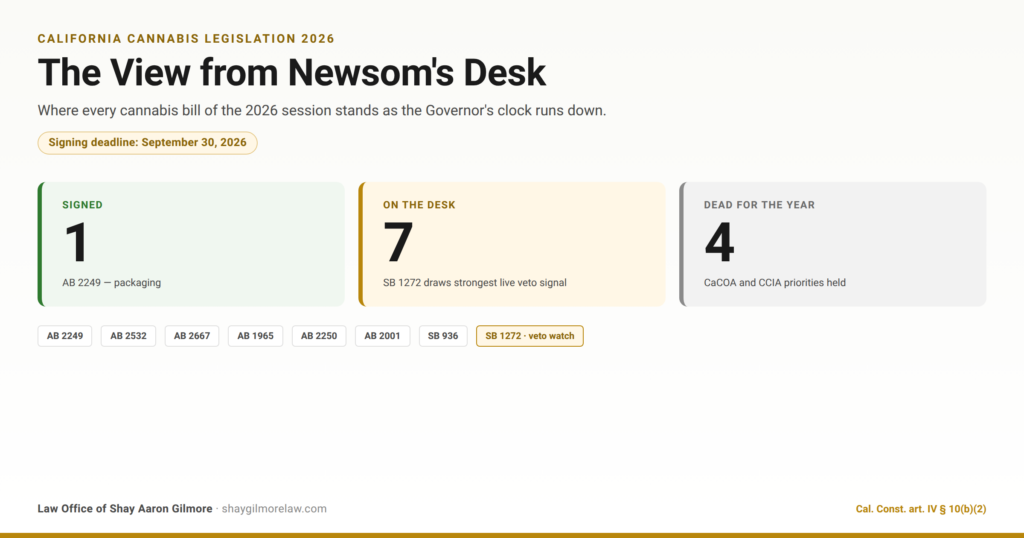
As the 2026 California legislative session closes, Governor Newsom has until September 30 to act on the year’s cannabis bills. One is already law: AB 2249 rewrites MAUCRSA’s “attractive to children” packaging standard. Seven wait on his desk — packaging labels (AB 2532), vape branding (AB 2667), testing labs (AB 1965), CBN classification (AB 2250), enforcement data-sharing (AB 2001), nitrous-linked license consequences (SB 936), and local administrative fines (SB 1272, drawing the strongest live veto signal). Four are dead for the year. A working scorecard from California cannabis attorney Shay Aaron Gilmore.
What SB 1064 and AB 179 Predict About DCC’s Combined Activities and Ownership Rulemaking
The California Department of Cannabis Control’s Summer 2026 rulemaking, “Combined Activities License and Ownership Updates,” will implement two 2024 statutes. SB 1064 (Ch. 991) authorizes combined cannabis activities at one premises under Business and Professions Code § 26001(m) and directs DCC to build a combined-activities licensing process under § 26070. AB 179 (Ch. 997) narrows Live Scan fingerprint requirements under § 26051.5(a)(1) so that only owners defined in § 26001(aq)(1)–(3) — the 20% aggregate holder, CEO or equivalent, and nonprofit board members — must submit fingerprints. The package will primarily amend 4 CCR § 15002 and § 15003 among 15 affected regulations. This post predicts what DCC’s proposed regulations will and will not include, applies the California APA purpose-and-scope constraints under Government Code §§ 11342.1 and 11342.2, and identifies the four drafting moves operators should prepare for now.
AB 1684 Cannabis Fines: What California Landlords and Tenants Need to Know

Since January 1, 2024, California cities can fine landlords and tenants $10,000 a day for unlicensed cannabis activity. Here’s what AB 1684 actually requires.
California’s Intoxicating Hemp Approach in Context: How the State’s Rules Compare to the Rest of the Country
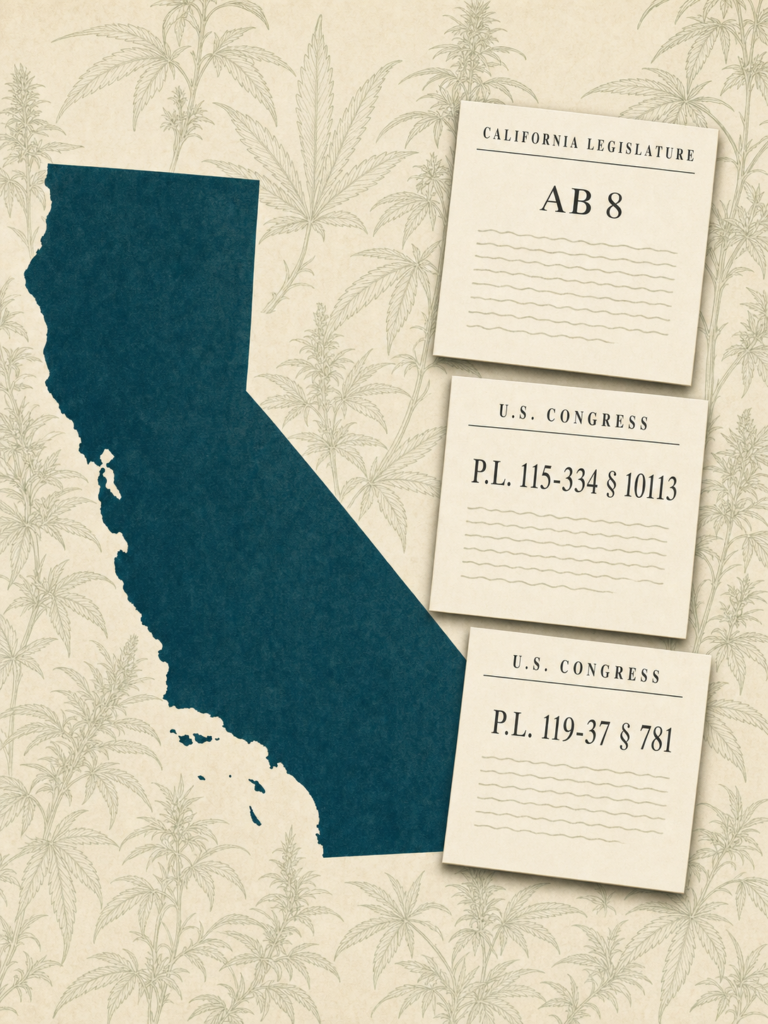
When § 781 of P.L. 119-37 takes effect, the federal intoxicating-hemp market that the 2018 Farm Bill inadvertently opened will close. California’s AB 8 is the state’s answer — and, for operators here, the only legal off-ramp. This post explains how the three laws fit together and what cannabis and hemp businesses need to do before the deadline arrives.
How California Retailers Are Splitting One A-and-M-Designated License into Two Under the DCC’s Emergency Rule

California’s June 4, 2026 emergency rule lets a dual-designated A and M retailer hold each license in a separate entity on the same premises. Here’s how.
How a Distressed California Cannabis Business Restructures When Bankruptcy Court Is Out of Reach

Distressed California cannabis firms can’t file federal bankruptcy—even after 2026 rescheduling. How workouts, ABCs, and receiverships work under state law.
What the Enforcement Numbers Don’t Show: California’s Intoxicating Hemp Beverage Market and the July 1 Consolidation
California’s hemp-enforcement numbers look like a win. Read as Holmes’ “bad man” would, they map where the intoxicating hemp beverage trade moved — and how fast the July 1, 2026 consolidation closes in on it.
The April 22 Rescheduling Order: What We Know, What We Don’t, and What to Watch Before June 29
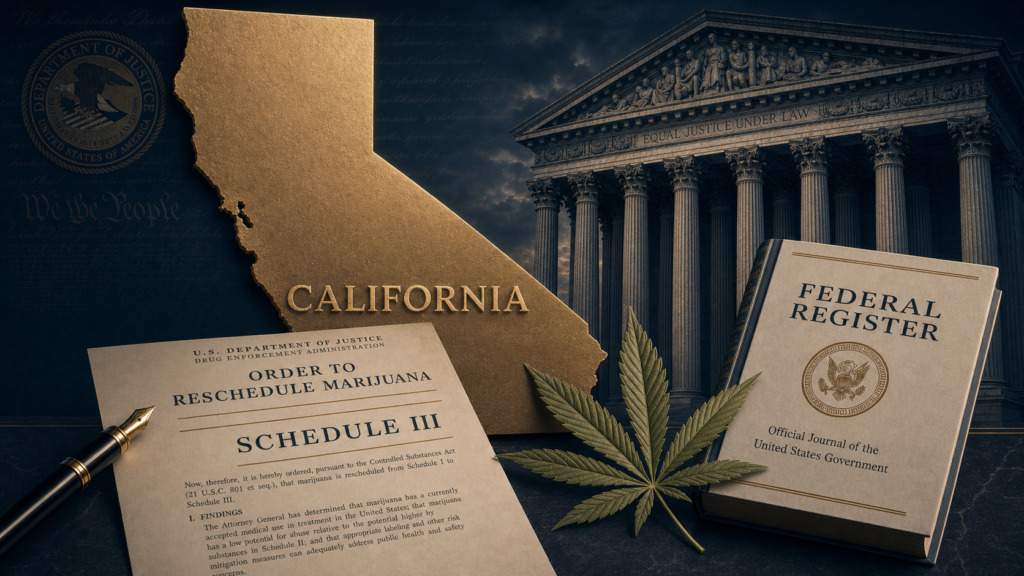
The April 22, 2026 rescheduling order moves state-licensed medical marijuana to Schedule III — but leaves adult-use cannabis in Schedule I, creates contested treaty-compliance mechanisms, and opens a June 27 DEA registration deadline that demands immediate attention from California dual A/M operators. Here is what we know, what remains genuinely uncertain, and what to watch before June 29.