CANNABIS AND HEMP BUSINESS LAW FIRM SERVING THE CENTRAL COAST
Cannabis and Hemp Business Lawyer Serving Throughout California
The Law Office of Shay Aaron Gilmore has helped dozens of businesses procure or maintain state and local commercial cannabis licenses and permits, successfully closed millions of dollars in mergers and acquisitions and other corporate transactions for cannabis and hemp investor and operator clients, and devoted hundreds of hours of pro-bono legal services to the cannabis social equity movement.
A recognized leader among California cannabis and hemp attorneys, Shay Aaron Gilmore offers legal solutions for operators and investors to launch, fund and grow businesses in compliance with the cannabis and hemp industries’ ever-changing regulations, laws and policies, with a focus on the Central Coast.
In addition to the Central Coast, the Law Office of Shay Aaron Gilmore also serves clients in:
Practice Areas in the Central Coast, California
We offer our clients customized knowledge and cost-effective legal counsel designed to reach their unique goals. The Law Office of Shay Aaron Gilmore supports the ongoing success of our Central Coast cannabis and hemp industry clients in the following practice areas:
Shay Aaron Gilmore serves as an active member and leader of top trade and professional organizations like the California Cannabis Industry Association, the American Bar Association Cannabis Law & Policy Committee, and the International Cannabis Bar Association. Shay founded the Cannabis Practitioners Group of the California Lawyers Association, which he chairs. Super Lawyers® Magazine has recognized Shay as a Northern California Super Lawyer in Business & Corporate Law and in Cannabis Law, and as one of the Top 100 Lawyers in Northern California across all practice areas. The state’s largest legal news periodical, The Los Angeles/San Francisco Daily Journal, has named Shay as one of the Top 20 Cannabis Lawyers in California. Shay currently serves on the Board of Directors of California NORML.
Central Coast Cannabis and Hemp Business Resources
Whether you are an already established California investor or operator expanding your business or investment into the Central Coast, or you are new to the California cannabis or hemp industries, getting an understanding of the legal requirements and regulations impacting the local cannabis and hemp industries is vital to your success. Here are just a few local resources for cannabis and hemp businesses to use in answering questions regarding cannabis and hemp legislation, regulation, and enforcement in the Central Coast.
- City of Santa Cruz Cannabis Business Tax
- City of Santa Cruz Cannabis License & Regulations
- City of Watsonville Cannabis Facilities
- City of Capitola Retail Cannabis Ordinance
- Santa Cruz County Cannabis Licensing
- San Benito Cannabis Business Regulatory Program
- City of Hollister Cannabis Affairs
- Monterey County Cannabis Program
- City of Salinas Commercial Cannabis
- City of San Luis Obispo Cannabis
- San Luis Obispo County Cannabis Services
- Santa Barbara County Cannabis Program
- City of Santa Barbara Commercial Cannabis
- San Luis Obispo County Industrial Hemp
- Santa Barbara County Industrial Hemp Program
- San Benito County Industrial Hemp
Have specific questions or concerns in the Central Coast? The Law Office of Shay Aaron Gilmore can customize legal solutions for your commercial cannabis and hemp investment or business needs.
Contact The Law Office of Shay Aaron Gilmore today!
Contact our Central Coast cannabis and hemp law specialists today by phone at (415) 846-6397 or online so you can compliantly and fully align your business and/or investment interests in the California cannabis and hemp industries.
Frequently Asked Questions
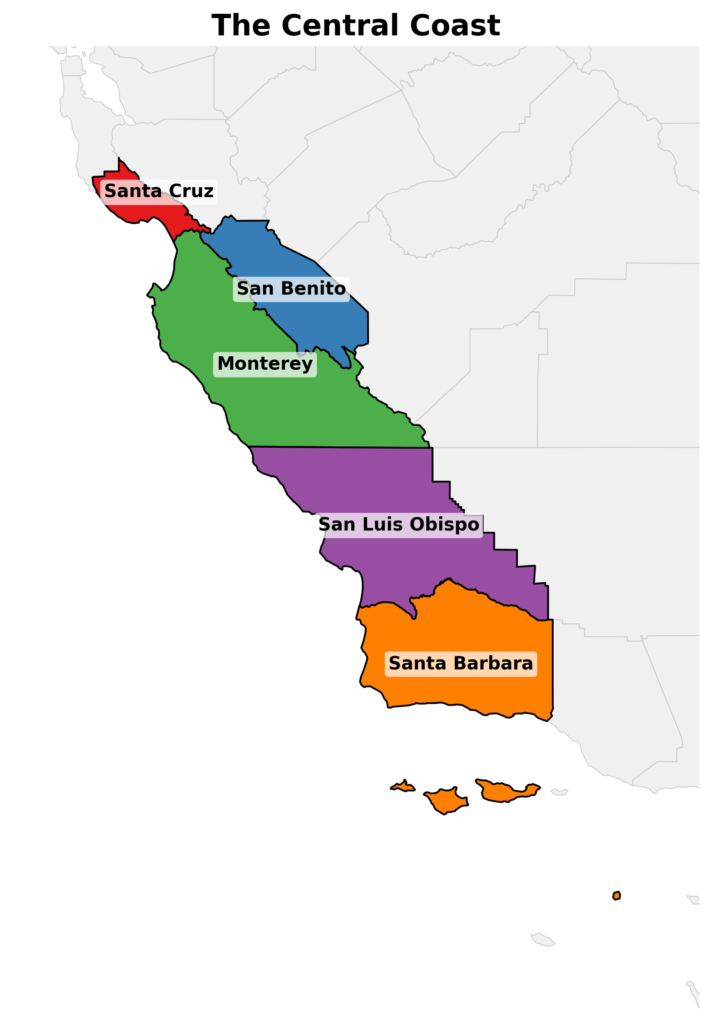
To get a cannabis license on California’s Central Coast, a business must first obtain local cannabis approval from the specific city or county with jurisdiction over the physical location of the premises and then obtain a state license from the Department of Cannabis Control (DCC). The Central Coast spans five counties — Santa Cruz, San Benito, Monterey, San Luis Obispo, and Santa Barbara — and each county, along with the cities within it, sets its own rules for whether commercial Central Coast cannabis activity is allowed and where stores selling cannabis on CA Central Coast can operate.
The permitting landscape varies widely: some jurisdictions have robust programs supporting retail dispensaries, manufacturing, distribution, and testing, while others prohibit most or all commercial cannabis activity. A Central Coast lawyer or business lawyer Central Coast clients rely on can guide prospective operators through the local permitting maze across these five counties, ensure compliance with each jurisdiction’s specific zoning and operational requirements, and then assist with the DCC state license application. Given the complexity of cannabis Central Coast regulations, engaging a commercial lawyer Central Coast practitioners recommend is a sound first step.
Central Coast cannabis growers must first obtain local cultivation approval in the specific county or city where the grow site is located and then secure a state cultivation license from the DCC. Cultivation rules differ markedly across the five Central Coast counties. Some counties — such as Santa Barbara and Monterey — have well-established cultivation programs with defined canopy limits, while others impose tighter restrictions or outright prohibitions on Central Coast cannabis grow operations.
A cultivator must verify that commercial cannabis cultivation is permitted on the specific parcel, obtain local land-use and cultivation authorization, and then submit a DCC cultivation application with detailed premises diagrams, water-source and environmental information, CEQA documentation, and proof of local approval. Because cultivation regulations, fees, and timelines differ so significantly across the Central Coast, many operators compare opportunities in multiple jurisdictions. Consulting a lawyer Central Coast cannabis businesses trust — or one of the established Central Coast law firms — helps cultivators navigate these differences and identify the most favorable location for their grow operation.
Before growing hemp on the Central Coast, a grower must register with the California Department of Food and Agriculture (CDFA) through the agricultural commissioner for the county in which the grower intends to cultivate. The Central Coast spans Santa Cruz, San Benito, Monterey, San Luis Obispo, and Santa Barbara counties, and each county agricultural commissioner may impose additional local requirements or restrictions on industrial hemp cultivation. Central Coast hemp processing operations must also comply with any applicable local manufacturing or processing permits.
Under CDFA rules, when a county is accepting registrations, the agricultural commissioner must issue the state registration within 30 calendar days if all state and local requirements are met. Prospective hemp growers should contact the relevant county agricultural commissioner’s office to confirm whether industrial hemp registrations are currently being accepted and what additional documentation is required. A lawyer California Central Coast hemp cultivators consult can help evaluate which county’s program best fits the grower’s plans.
Before cultivation, a fee of $900 per applicant must be submitted with the Industrial Hemp Registration Application to the California Department of Food and Agriculture (CDFA). The $900 CDFA fee is annual and must be paid again each year to renew the registration; a separate registration (and fee) is required for each Central Coast county in which the grower cultivates. County fees across the Central Coast are in addition to the $900 CDFA registration and vary by jurisdiction.
Operators interested in Central Coast hemp processing should also factor in any local manufacturing or processing permit fees imposed by the relevant city or county. Prospective hemp cultivators should contact the agricultural commissioner’s office in the specific Central Coast county where they intend to cultivate to confirm the most current local fee amounts before applying. The established law firms Central Coast operators work with can advise on total anticipated costs.