Cannabis and Hemp Business Law Firm Serving The Southern Border Region
Cannabis and Hemp Business Attorney Serving Clients Throughout California
The Law Office of Shay Aaron Gilmore has helped dozens of businesses procure or maintain state and local commercial cannabis licenses and permits, successfully closed millions of dollars in mergers and acquisitions and other corporate transactions for cannabis and hemp operator and investor clients, and devoted hundreds of hours of pro-bono legal services to the cannabis social equity movement.
Recognized as a leader in California cannabis and hemp law, Shay Aaron Gilmore provides proven legal solutions for investors and operators to launch, fund and grow ventures in compliance with the cannabis and hemp industries’ ever-changing laws, regulations and policies, with a focus on The Southern Border Region.
In addition to the Southern Border Region, the Law Office of Shay Aaron Gilmore also serves clients in:
Practice Areas in the Southern Border Region, California
We provide every one of our clients customized knowledge that translates into cost-effective legal counsel designed to reach their unique goals. The Law Office of Shay Aaron Gilmore supports the ongoing success of our Southern Border Region cannabis and hemp industry clients in the following practice areas:
Recognized by The Los Angeles/San Francisco Daily Journal as one of the Top 20 Cannabis Lawyers in California, Shay Aaron Gilmore maintains active roles in top trade and professional organizations like the American Bar Association Cannabis Law & Policy Committee, the California Cannabis Industry Association, and the International Cannabis Bar Association. Shay founded the Cannabis Practitioners Group of the California Lawyers Association, which he chairs. Shay has been recognized by Super Lawyers® Magazine as a Super Lawyer in Cannabis Law and in Business & Corporate Law. Chambers and Partners recognize Shay in Cannabis Law: Western United States (Band 4) in its flagship Chambers USA guide. A complete list of Shay’s recent presentations, white papers, and legal articles is available on the Media page. Shay currently serves as a member of the Board of Directors of California NORML. Shay regularly publishes content for the Southern Border Region on his Cannabis and Hemp Law Blog.
Southern Border Region Cannabis and Hemp Business Resources
Whether you are an established California operator or investor expanding your business or investment into the Southern Border Region, or you are just starting up in the California cannabis or hemp industries, understanding the legal requirements and regulations impacting the local cannabis and hemp industries is vital to your success. Here are just a few local resources for cannabis and hemp businesses to use in answering questions regarding cannabis and hemp legislation, regulation, and enforcement in a number of cities within the Southern Border Region, and in the region’s unincorporated area.
- City of San Diego Cannabis Information
- San Diego County Cannabis Program
- San Diego County Code, Tit. 2, Div. 1, Ch. 25
- City of San Diego Cannabis Business Tax
- City of Encinitas Cannabis Ordinance
- City of La Mesa Cannabis Businesses
- City of Imperial Beach Code Tit. 19, Ch. 19.61
- City of Chula Vista Commercial Cannabis
- National City Commercial Cannabis Information
- City of Vista Cannabis Businesses
- City of Lemon Grove Cannabis Regulations
- City of Oceanside Cannabis Ordinance
- City of Santee Cannabis Businesses
- San Diego County Industrial Hemp Cultivation
- Imperial County Industrial Hemp Program
- Imperial County Commercial Cannabis
If you have specific questions or concerns in the Southern Border Region, then the Law Office of Shay Aaron Gilmore can provide specialized legal solutions for your cannabis and hemp business or investment needs.
Contact The Law Office of Shay Aaron Gilmore today!
Contact our Southern Border Region cannabis and hemp law specialists today by phone at (415) 846-6397 or online so you can fully and compliantly align your business and/or investment interests in the California cannabis and hemp industries.
Frequently Asked Questions
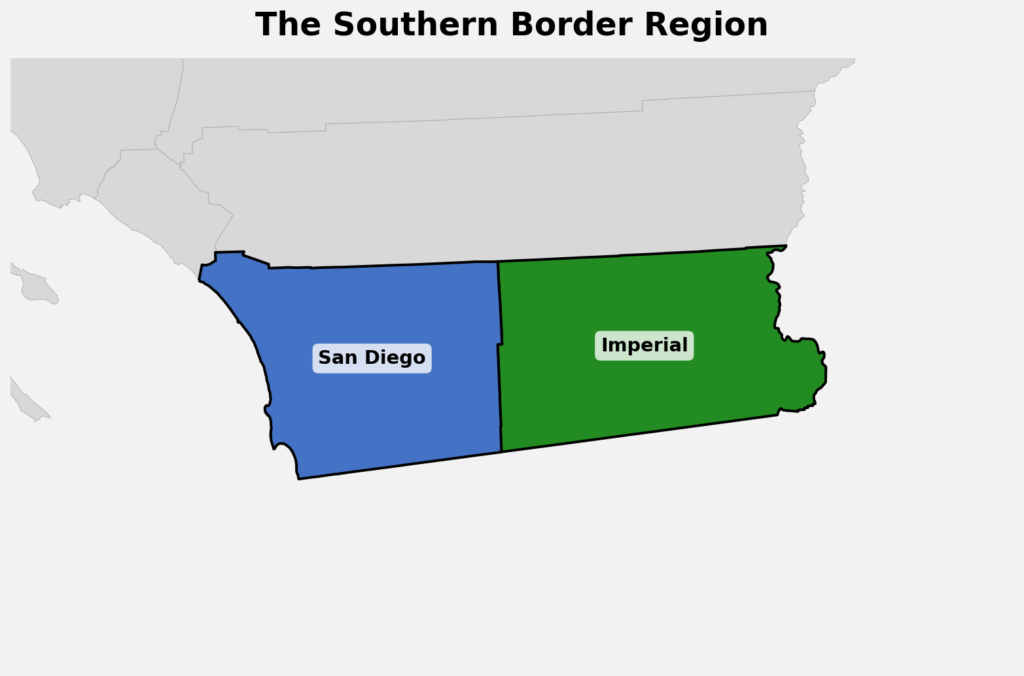
To get a cannabis license in the Southern Border Region, a business must first obtain local cannabis approval in the jurisdiction where it will operate and then secure a matching state license from the Department of Cannabis Control (DCC). The Southern Border Region spans two counties — San Diego County and Imperial County — and each county, along with the cities within it, sets its own rules for whether commercial cannabis is allowed and where.
In the Southern Border Region, local approval may come from a city such as the City of San Diego, Chula Vista, La Mesa, Vista, Encinitas, National City, or Imperial Beach, or from unincorporated San Diego County. Each city’s cannabis ordinance under the Southern Border Region cannabis law sets its own rules for location, caps, and operating standards. In Imperial County, the landscape varies: unincorporated Imperial County permits certain commercial cannabis activities — including cultivation and limited distribution — under the voter-approved Measure Y, subject to a cap on the number of cultivation operations, while among the cities Calexico allows a range of commercial cannabis activities and El Centro prohibits all commercial cannabis activity. DCC will only issue a state license to an applicant who has first obtained all required local approvals.
Cannabis regulations vary significantly by jurisdiction across the region. Those looking for cannabis dispensaries in the Southern Border Region, to open new San Diego cannabis dispensaries, or to operate in Imperial County should review the local cannabis zoning map and the ordinance for the target city. The cannabis business tax and cannabis tax obligations also vary by city, and operators must factor in both local taxes and state excise taxes. Cannabis consulting professionals and a San Diego cannabis lawyer businesses trust can guide applicants through the local permitting and state licensing process in both San Diego and Imperial Counties.
Cannabis cultivation in the Southern Border Region begins with local cultivation approval in the specific city or unincorporated county area where the grow site will operate, followed by a state cultivation license from DCC. Cultivation rules vary by jurisdiction across the region’s two counties — San Diego County and Imperial County.
In San Diego County, growing cannabis is permitted in some cities and in unincorporated San Diego County commercial cannabis zones, while other jurisdictions restrict or prohibit cannabis cultivation. In Imperial County, unincorporated areas allow commercial cannabis cultivation under the voter-approved Measure Y — subject to a cap on the total number of cultivation operations countywide — and the City of Calexico permits commercial cultivation, while cities such as El Centro prohibit it.
A cultivator must verify that commercial cannabis cultivation is allowed on the specific parcel under the applicable county and city cannabis laws, obtain local land-use and cultivation authorization, and then submit a DCC cultivation application with site plans, water and environmental information, CEQA documentation, and proof of local authorization. Understanding the nuances of cannabis cultivation laws in both San Diego County and Imperial County is critical for site selection. A Southern Border Region cannabis business lawyer cultivators rely on can navigate these regulations and advise on optimal grow locations.
Before growing hemp on land within the Southern Border Region, a grower must register with the California Department of Food and Agriculture (CDFA) through the agricultural commissioner for the county in which the grower intends to cultivate. The Southern Border Region spans two counties — San Diego County and Imperial County — and registration is handled by the San Diego County Agricultural Commissioner and the Imperial County Agricultural Commissioner, respectively. Under CDFA rules, when a county is accepting registrations, the agricultural commissioner must issue the state registration within 30 calendar days if all state and local requirements are met.
Each county agricultural commissioner may impose additional local requirements or restrictions on industrial hemp cultivation, including zoning limits, setbacks, and site-specific documentation. Imperial County, for example, administers an industrial hemp registration program through its Agricultural Commissioner and has adopted a Voluntary Industrial Hemp Transportation Policy to assist growers transporting hemp through U.S. Customs and Border Protection checkpoints. Prospective hemp growers in either county should contact the relevant county agricultural commissioner’s office to confirm whether industrial hemp registrations are currently being accepted and what local conditions apply beyond the standard CDFA Industrial Hemp Registration Application. A Southern Border Region hemp lawyer or attorney experienced in agricultural regulations can assist with navigating local hemp requirements.
Before cultivation, a fee of $900 per applicant must be submitted with the Industrial Hemp Registration Application to the California Department of Food and Agriculture (CDFA). The $900 CDFA fee is annual and must be paid again each year to renew the registration; a separate registration (and fee) is required for each county in which the grower cultivates. County fees in the Southern Border Region — including in San Diego County and Imperial County — are in addition to the $900 CDFA registration and vary by jurisdiction to cover administration and enforcement costs.
Prospective hemp cultivators should contact the relevant county agricultural commissioner’s office — the San Diego County Agricultural Commissioner or the Imperial County Agricultural Commissioner — to confirm the most current local fee amounts before applying. A Southern Border Region cannabis attorney or hemp lawyer operators trust can advise on total anticipated costs, including any applicable local business tax obligations. For businesses also handling CBD hemp products, regulatory compliance professionals should be consulted to ensure both cultivation and product-level compliance, and a cannabis tax lawyer or cannabis tax accountant can advise on the tax implications of hemp cultivation and sales in the region.